
Palm tree trimming in New Orleans should remove far less than most homeowners assume. The safe rule is to cut only fully brown, dead fronds and leave anything still holding green, because those fronds are still feeding the tree. Stripping a palm to a narrow tuft, often called a hurricane cut, exposes the growing bud and can leave it more vulnerable to storm damage, not less. For the palm, no season is better than another for routine work.
At TurnKey Tree Cutting, we get called out to palms more often for over-trimming than for neglect. The tall palms scattered across the city are part of what makes New Orleans look like New Orleans, and they are also the tree homeowners misunderstand most.
Here’s the thing: a palm is not built like an oak. It does not put on new rings, it does not seal over cuts the way a hardwood does, and every green frond it carries is still doing a job.
That difference changes almost everything about how a palm should be maintained. Contact us today to have us look at your palms and tell you honestly whether they need anything cut at all.
What Makes Palms Different From Every Other Tree in Your Yard
Palms behave less like the hardwoods around them and more like very tall grass. Once you understand that, the care rules stop feeling arbitrary.
There’s Only One Growing Point
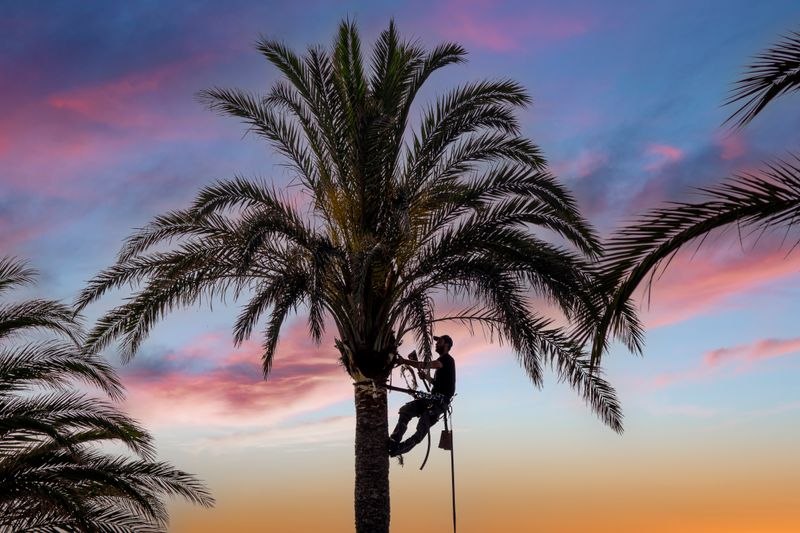
A palm grows from a single bud at the top of each trunk, and that bud is the whole tree. An oak can lose a limb and push new growth somewhere else, but a palm has no backup.
Damage that bud and the palm does not recover. That is why anything done near the crown carries more consequence than the same cut would on a hardwood.
It Can’t Seal a Wound the Way a Hardwood Does
Hardwoods compartmentalize damage, walling off an injury so the tree can keep growing around it. Palms do not have that machinery.
A cut into the trunk stays there for the life of the tree. It is a permanent scar and a permanent entry point, which is a solid reason to keep tools away from the trunk itself.
The same logic rules out climbing spikes on a palm you intend to keep. Every spike leaves a puncture the trunk can never close over, so crews working a healthy palm should reach the crown with a ladder or a lift instead.
Green Fronds Are Still Feeding It
Every frond holding green is producing energy the palm needs to push new growth and get through stress. Removing them takes food off the table.
That includes fronds that look tired or partly discolored (the ones homeowners most want gone). If there is green in it, the palm is still using it.
The Trunk You See Is Already Final
A palm trunk does not thicken over the years the way a hardwood trunk does. What you see is essentially what you get.
That matters when the palm is stressed young, because a thin section of trunk from a rough year stays thin permanently. Consistent care early shows up in the tree decades later.
Okay, So What Should Actually Get Cut?
Real talk: on a healthy palm, the honest answer is usually “not much.” Here is what earns a cut and what does not.
Fully Brown, Dead Fronds
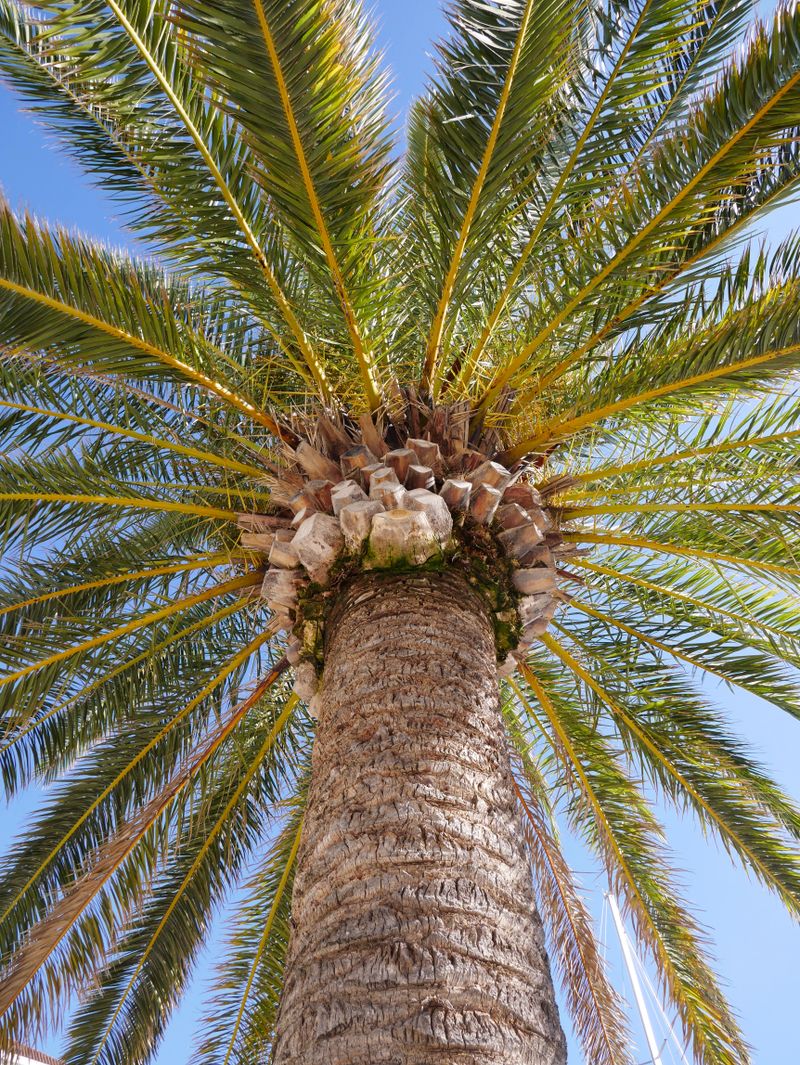
This is the safe category. Guidance from the University of Florida’s Institute of Food and Agricultural Sciences (UF/IFAS) is to remove only fully brown fronds, since dead ones do not damage the palm or threaten its health.
Lower fronds dying off while new ones push from the top is just how a palm works. Clearing the fully dead ones is tidy and harmless. The practical version of the rule is to take only the completely brown fronds that already hang below horizontal.
Loose or Hanging Fronds After a Storm
Broken and hanging fronds are worth taking down promptly, mostly because of what is underneath them. A frond dangling over a driveway or walkway is a safety issue before it is an appearance issue.
Bent or bruised fronds are a different story. If they still hold green, leaving them until they turn fully brown helps the palm rebuild its energy reserves after the storm. The one exception is a broken frond draped across the top of the palm, which should come off because it can block the new fronds trying to emerge.
Fruit Stalks and Seed Pods
Flower and fruit stalks are fair to remove, and doing it keeps seedlings and dropped fruit out of your yard and gutters. It also spares the palm some of the energy it would spend on seed production.
This is one of the few cuts where the timing is flexible. Taking stalks off as they appear is easier than dealing with the mess later.
The Hurricane Cut Thing (It Really Does Hurt Them)
You have seen it around town: a palm stripped back until only a few fronds point straight up, sometimes called a hurricane cut. The reasoning sounds logical, which is exactly why it spread.
The evidence points the other way. UF/IFAS reports that some arborists found palms with many lower fronds removed were damaged in the hurricane more than palms that were not pruned at all, because removing too many fronds exposes the delicate bud to more wind.
So the cut that was supposed to storm-proof the palm can do the opposite. On the Gulf Coast, where the wind actually shows up, that is a costly thing to get backward.
When Palm Tree Trimming in New Orleans Makes Sense (Season Is Not the Deciding Factor)
There is no single best season for routine palm work. UF/IFAS guidance is that no time of year is better than another from the palm’s perspective, so the work can be done whenever it is convenient as long as the rules about what to cut are followed.
That makes restraint the real variable, not the calendar. A palm trimmed lightly in any month is in better shape than one stripped hard in a supposedly ideal one.
Storm damage is the exception, and it does not wait for a season. Anything hanging or broken after a blow should come down when it is safe to do so, while everything still green stays put. Our tree trimming crews work to that standard year-round.
Bottom Line
Most palms in New Orleans would be healthier with less cutting, not more. Take the dead fronds, leave the green ones, and keep tools off the trunk and away from the bud.
At TurnKey Tree Cutting, we will tell you when your palm needs work and when it honestly does not, and we handle tree fertilization when a palm needs feeding rather than cutting. Call us today to have your palms looked at before anyone touches them.