
In New Orleans, the trees most vulnerable to storm damage include laurel oak, water oak, pecan, and southern red oak, which University of Florida hurricane studies place in their lowest wind-resistance group. Live oak, southern magnolia, baldcypress, and sabal palm rank among the most wind resistant. Species is only part of the story, though, because decay, weak structure, damaged roots, and age raise the risk for any tree.
At TurnKey Tree Cutting, we see the same pattern after storms move through New Orleans. One tree drops a huge limb or goes over completely, while the tree next door barely loses a leaf.
Part of the reason is species, and the research on which trees hold up in hurricane winds is more specific than most people expect. University of Florida IFAS researchers measured urban trees after a series of hurricanes across Florida and the Gulf Coast and rated how common species performed.
Below is how the trees you are likely to have stack up, and what else changes the picture. Contact us today to have the trees on your property checked for storm risk.
So Which Trees Break Most Often?
The trees most likely to break or fall in a storm are the species UF/IFAS places in its lowest wind-resistance group, which includes laurel oak, water oak, pecan, and southern red oak. Several fast-growing ornamentals sit in that same group. UF/IFAS built those groups from its own hurricane measurements and a survey of arborists, scientists, and urban foresters who ranked species after storms.
Here’s how those species break down.
Laurel and Water Oaks Top the Worry List
Laurel oak is the clearest case in the research. Across four Florida Panhandle hurricanes, UF/IFAS found laurel oak had poorer overall survival than both live oak and sand live oak.
Water oak sits in the same lowest group. It also tends to hollow out with age, which is why trimming one often starts with deciding whether a limb is worth keeping at all.
These oaks grow fast and get big, so a failing one near a house is a real hazard rather than a cosmetic problem.
Pecans and Southern Red Oaks Are Close Behind
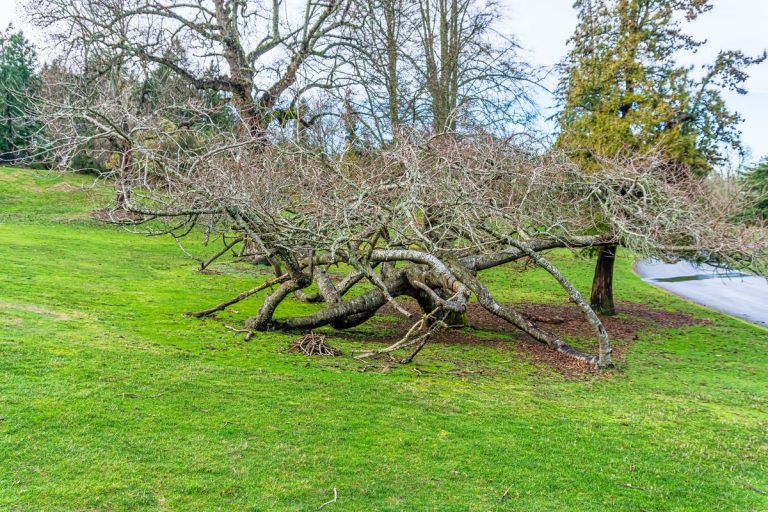 Pecan and southern red oak also land in the UF/IFAS lowest wind-resistance group. Both can grow into large trees with heavy limbs, which makes a failure more damaging when it happens.
A big pecan over a roof or driveway deserves a closer look before storm season than a small one at the back of the lot. Size and placement multiply whatever weakness the species already has. UF/IFAS names pecan, laurel oak, and water oak among the species to inspect once they are over-mature.
Watch the Fast-Growing Ornamentals
Bradford pear, Chinese tallow, and Chinese elm also sit in the lowest group in the UF/IFAS ratings. They’re popular because they grow quickly and look good young, but quick growth doesn’t translate into strong wood.
Among palms, the Washington fan palm is the weak one. UF/IFAS lists it in the lowest group and notes it performed poorly in south Florida hurricanes.
Pines Can Fool You
The common southern pines (slash, longleaf, and loblolly) sit in a medium-low group rather than the bottom one. The catch is what happens after the storm.
UF/IFAS found that pines can look green and healthy right after a hurricane and still die over the following months. A pine that came through a storm looking fine isn’t necessarily in the clear, so it’s worth watching.
And Which Trees Handle Storms Best?
The most wind-resistant trees in the UF/IFAS ratings include live oak, southern magnolia, crape myrtle, baldcypress, and sabal palm. None of them is storm-proof, but they consistently came through hurricanes in better shape. These ratings cover what UF/IFAS calls the Southeastern Coastal Plain (USDA hardiness zones 8 and 9), and New Orleans sits in zone 9b.
Live Oaks Earn Their Reputation
Live oak sits in the highest wind-resistance group, and UF/IFAS notes that many sources point to it as a tree with strong wood and little failure in hurricanes. UF/IFAS research on Hurricane Ivan found that trees losing their leaves survived better, and live oak readily sheds leaves and small branches in high winds.
That reputation still depends on care. Our guide to protecting live oak trees covers why their heavy horizontal limbs and root zones need attention.
Southern Magnolia and Crape Myrtle Hold Their Own
Southern magnolia and crape myrtle both rank in the highest group for the Southeastern Coastal Plain. So do American holly, yaupon holly, and dogwood among smaller trees.
Crape myrtles do lose that advantage when they’re topped. Cutting them back to stubs produces weak regrowth that fails later, which undoes the benefit of planting a sturdy species. UF/IFAS lists crape myrtle and dogwood among the small trees suited to spots under power lines.
Baldcypress Is the Standout Conifer
Baldcypress and pondcypress sit in the highest group among conifers, well above the pines. For a big conifer on a wet New Orleans lot, baldcypress is the one the wind ratings favor.
UF/IFAS also lists it as a long-lived species. That matters, because a tree’s risk of failure tends to climb as it ages. Rooting space counts too, since UF/IFAS found trees with more room for their roots were less likely to fail in wind.
Sabal Palms Can Lose Every Frond and Live
As a group, palms survived hurricanes better than broad-leaved trees and pines in the UF/IFAS research. Sabal palm is in the highest group and is cited as naturally resistant.
The reason is the single growing bud at the top. If that bud is not damaged, a palm can lose all its fronds and still survive, although bud damage can take months to show.
Species Isn’t the Whole Story (Not Even Close)
UF/IFAS presents its lists with a plain caveat: no tree is perfectly wind-proof, and soil, wind intensity, past care, health, and age all play a part. A neglected live oak can fail while a well-kept laurel oak rides out the same storm.
Decay is a big one. Cracks, seams, swelling at the base, dead branch stubs, and mushrooms at the trunk can all signal internal rot, according to UF/IFAS.
Structure and roots matter too. Two equal stems growing from one point often form a weak union, older and larger trees lose more branches in hurricanes, and trees with roots cut under the canopy are more likely to blow over.
What About the Trees Already in Your New Orleans Yard?
You don’t need to cut down every laurel oak on the block. UF/IFAS recommends inspecting over-mature trees and species with poor hurricane survival, then removing the ones at high risk, especially when they threaten people or property.
For the rest, the same research favors a regular structural pruning program for young and mature trees. Our tree trimming service focuses on deadwood and weak unions rather than stripping canopy.
When a weak tree does have to go, our tree removal crew takes it down in rigged sections when a tight lot leaves no clear drop zone. UF/IFAS suggests replacing it with a more wind-resistant species and mixing species and ages across the yard.
The Bottom Line on Storm-Vulnerable Trees
Species gives you a head start on knowing which trees to worry about, with laurel oak, water oak, and pecan near the top of the list. The condition of each individual tree is what decides whether it actually fails.
At TurnKey Tree Cutting, our certified arborists look at both the species and the shape it’s in before recommending pruning or removal. Call us today to have our licensed and insured crew check the trees around your home.
Frequently Asked Questions
What trees are most likely to fall in a hurricane?
Trees in the UF/IFAS lowest wind-resistance group are the most likely to fail, including laurel oak, water oak, pecan, southern red oak, Bradford pear, and Chinese tallow. Any tree with decay, a weak trunk union, or cut roots is at higher risk too, whatever its species. Large, old trees also lose more branches.
Are live oaks good in hurricanes?
Yes. Live oak ranks in the highest wind-resistance group in UF/IFAS hurricane studies, and many sources describe it as having strong wood and little failure in storms. It still needs care, because decay, damaged roots, or poor pruning can weaken even a live oak over time.
Are pine trees safe during hurricanes?
Pines are a middle-of-the-pack risk. Slash, longleaf, and loblolly pines sit in a medium-low wind-resistance group in UF/IFAS ratings. The bigger concern is delayed decline, since pines can look healthy right after a hurricane and still die over the following months, so keep watching them.
Are water oaks dangerous?
Water oaks aren’t dangerous by default, but they are one of the weaker species in storms. UF/IFAS places water oak in its lowest wind-resistance group, and older water oaks often hollow out inside. A large water oak near a house is worth having assessed for decay before the next storm.
Do palm trees survive hurricanes?
Many do. UF/IFAS found that palms as a group survived hurricanes better than broad-leaved trees and pines, and sabal palm ranks among the most resistant. A palm can lose every frond and recover if its growing bud survives, though Washington fan palms are the weak exception.
What is the most wind resistant tree?
No tree is wind-proof, but live oak, sand live oak, southern magnolia, baldcypress, and sabal palm sit in the highest wind-resistance group in UF/IFAS research for the Southeastern Coastal Plain. Smaller trees in that group include crape myrtle, dogwood, and American holly.
Should I remove a laurel oak near my house?
Not automatically, though laurel oak is one of the weaker species in hurricanes. A large or old one close to a house deserves an inspection for decay, cracks, and weak unions. If it shows those defects, removal is often the safer choice, while a sound one may only need pruning.
Do older trees fall more in storms?
Generally, yes. UF/IFAS research found that larger, older trees lost more branches in hurricanes than small ones. Older trees also become more prone to decay and pests and less flexible as they age, so over-mature trees near homes deserve a regular check.