
A tree hit by lightning in New Orleans usually shows a long, narrow strip of bark blown off the trunk, running straight down or spiraling around it. Heavier strikes leave deep cracks, split the trunk, or blast away part of the canopy. Some trees show little outside damage at first, then wilt and brown within days or decline months later from hidden injury to the trunk and roots.
At TurnKey Tree Cutting, we get calls after thunderstorms from owners who heard a crack close by and later found a fresh scar running down a tree. Others only notice weeks afterward, when a tree that looked fine starts browning from the top.
Lightning damage ranges from a cosmetic scar to a tree that is failing from the inside. Knowing what each sign means helps you decide whether to watch the tree, care for it, or take it down.
Below is what to look for and how an assessment sorts it out. Contact us today to have a lightning-struck tree checked before it becomes a hazard.
What Lightning Damage Looks Like at First Glance
Lightning damage usually looks like a narrow strip of bark blown off the trunk, running straight down or spiraling around it. Alabama Cooperative Extension describes damage ranging from that single strip to deep cracks, a split trunk, a completely stripped trunk, or part of the canopy blasted away.
The pattern is not always tidy. According to the same Alabama Extension guidance, lightning can travel from the top of a tree to its roots, spiral down the trunk, or jump from branch to branch.
The tallest trees are the most likely targets, including lone trees standing in open ground. On a New Orleans lot, that is often the one big tree that stands above the roofline.
Visible Signs of a Strike on the Trunk and Limbs
Most of what you can see is on the trunk. These are the signs we look for first, and what each one tells us.
A Narrow Strip of Missing Bark Down the Trunk
The classic lightning mark is a long, narrow strip where bark has been blown away, exposing the wood underneath. Alabama Extension notes it may run straight down the trunk or spiral around it.
A single, narrow strip is usually the least serious form of damage. Nebraska Extension notes that the range runs from that strip all the way to a completely debarked tree, and Alabama Extension adds that the larger the wound, the greater the potential for future decay.
Deep Cracks or a Split Trunk
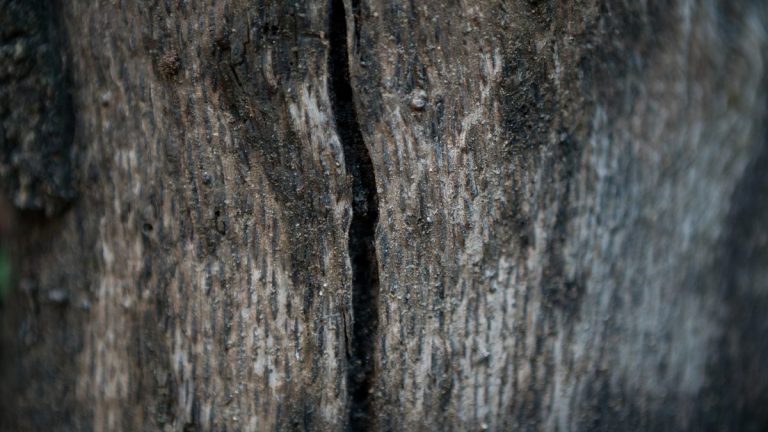 Deep vertical cracks in the trunk or main limbs mean the strike went beyond the bark. A trunk that has split open is the most serious visible sign.
Both Nebraska Extension and Alabama Extension treat a split trunk as a removal case. A split tree near a house, driveway, or play area should be dealt with promptly rather than watched.
Broken or hanging limbs left in the canopy also belong in this category. They can drop without warning and need to come down before anyone works or plays underneath.
Loose, Jagged Bark Around the Scar
Bark at the edges of a lightning wound is often left loose and torn. Exposed wood around the scar gives decay and insects an easy way in, according to Alabama Extension.
Cleaning those edges is called bark tracing. The loose, jagged bark is cut back with a sharp knife, without enlarging the wound, so the tree can begin to seal it.
Nebraska Extension notes that bark still attached and moist underneath can sometimes be nailed back in place and covered with burlap or plastic for several months. Loose bark that cannot be saved is trimmed back to healthy tissue instead.
Signs That Appear Days or Weeks Later
Some of the worst lightning damage is invisible on the day of the storm. This is why a tree that looks fine the next morning still deserves a follow-up look.
Leaves That Wilt and Brown Suddenly
Alabama Extension notes that a superheated charge can disrupt larger parts of the trunk or roots without leaving much outside sign. Trees can appear to die suddenly as leaves wilt and turn brown days after the strike.
Browning that starts in one section of the canopy, matching the side of the scar, points to the same cause. It helps to photograph the canopy every week or two after a strike to track any change.
Bark Beetles on Struck Pines
Lightning-damaged trees give off compounds that draw insects, according to Alabama Extension. In pines the likely problems are Ips, southern pine, and black turpentine beetles, while ambrosia beetles are the main concern in hardwoods.
In pines, Alabama Extension notes that Ips beetle attacks are common in the days or weeks after a strike. In hardwoods, sawdust at the base of the trunk or in bark crevices is a sign of ambrosia beetles.
Timing matters here. Alabama Extension notes that once these beetles bore into a tree, no labeled product can control them, so a struck pine should be looked at within days.
Decline That Starts in the Roots
Some trees show few signs of damage and still die later from root injury, according to Nebraska Extension. The canopy thins over a season or more while the trunk looks normal.
This slow decline can look like drought stress, which is easy to misread in a hot New Orleans summer. A tree that was struck and then fades is worth assessing rather than simply watering harder.
Nebraska Extension also notes that some trees die right away, while others survive what looks like severe damage and keep growing. Alabama Extension explains that the roots and water-conducting vessels may be damaged, which is why deep watering in dry spells helps a struck tree.
How an Assessment Decides Whether the Tree Stays
Alabama Extension states plainly that there are no fixed guidelines for predicting whether a struck tree will survive. Assessments rely on a few practical markers, set out below.
| Factor | What It Suggests | What Helps |
|---|---|---|
| Superficial scar, under a third of the trunk’s diameter | A good candidate for observation | Bark tracing, watering in dry spells, monitoring |
| Bark stripped from a third or more of the trunk’s circumference | A large wound with high potential for future decay | Removal is often worth considering |
| More than a third of the canopy lost, with significant scarring | Too little left to recover well | Removal is often worth considering |
| Split trunk or deep trunk cracks | Structural failure risk | Prompt removal, especially near the house |
Alabama Extension recommends waiting several weeks before removing or even pruning a struck tree, so hidden damage can become evident, though it advises removing a tree that has split. In dry spells, it advises a deep watering that moistens the top 6 to 9 inches of soil, limited to once or twice a week.
Hanging limbs are cleared by our tree trimming crew, and trees that fail the markers above go to our tree removal team.
Get a Lightning-Struck Tree Checked Before It Fails
A lightning scar does not always mean a dying tree, but it does mean the tree needs a closer look in the weeks after the storm. Catching beetles, cracks, or a fading canopy early keeps the decision in your hands.
At TurnKey Tree Cutting, our certified arborists check struck trees for the damage you can see and the damage that comes later. Call us today to schedule an assessment with our licensed and insured crew.
Frequently Asked Questions
Can a tree survive a lightning strike?
Many trees do, especially when the damage is a single narrow strip of bark and the trunk is not split. Survival is hard to predict, though, because hidden damage inside the trunk and roots may not show for days or months. Alabama Extension notes there are no fixed guidelines, so watching the tree after a strike matters.
How long does it take for a tree to die after being struck by lightning?
It varies widely. Some trees wilt and brown within days of the strike, while others show few signs and decline over the following months from root injury. Struck pines can also be killed by bark beetles drawn to the damaged wood, which is why pines need a prompt look.
Should I cut down a tree that was struck by lightning?
Not automatically. A tree with a split trunk, deep cracks, or a large share of its bark or canopy gone is usually a removal. A tree with a narrow surface scar is often worth keeping and watching, and Alabama Extension suggests waiting several weeks before deciding, while hanging limbs or a split trunk need attention sooner.
Is a tree struck by lightning dangerous?
It can be. A split trunk, deep cracks, or broken limbs hanging in the canopy can fail without warning, especially in the next storm. Keep people and vehicles clear of any struck tree with those signs until it has been assessed, and treat one leaning toward the house as urgent.
Does homeowners insurance cover a tree struck by lightning?
Lightning is commonly one of the covered perils in homeowners policies, particularly when a struck tree damages an insured structure. Coverage for removing a tree that falls and hits nothing is often limited or excluded. Terms vary, so check your own policy, and see our guide to homeowners insurance and tree removal.
What attracts lightning to a tree?
Height and exposure are the main factors. Alabama Extension notes that the tallest trees, including lone trees in open fields and trees on high ground, have the greatest chance of being struck. Trees are often the tallest objects around and conduct electricity reasonably well, which makes them natural lightning rods.
Can lightning strike the same tree twice?
It can. Alabama Extension notes that site history matters and that several struck trees in one small area are common. A tall, exposed tree that was hit once stays tall and exposed, so it pays to keep an eye on it after later storms as well.
How do you treat a tree after lightning damage?
Start by having any hanging limbs removed and the loose, jagged bark around the scar cleaned up with a sharp knife. Water deeply during dry spells, watch struck pines for beetle activity, and wait several weeks to see how the canopy responds before deciding on major pruning or removal.